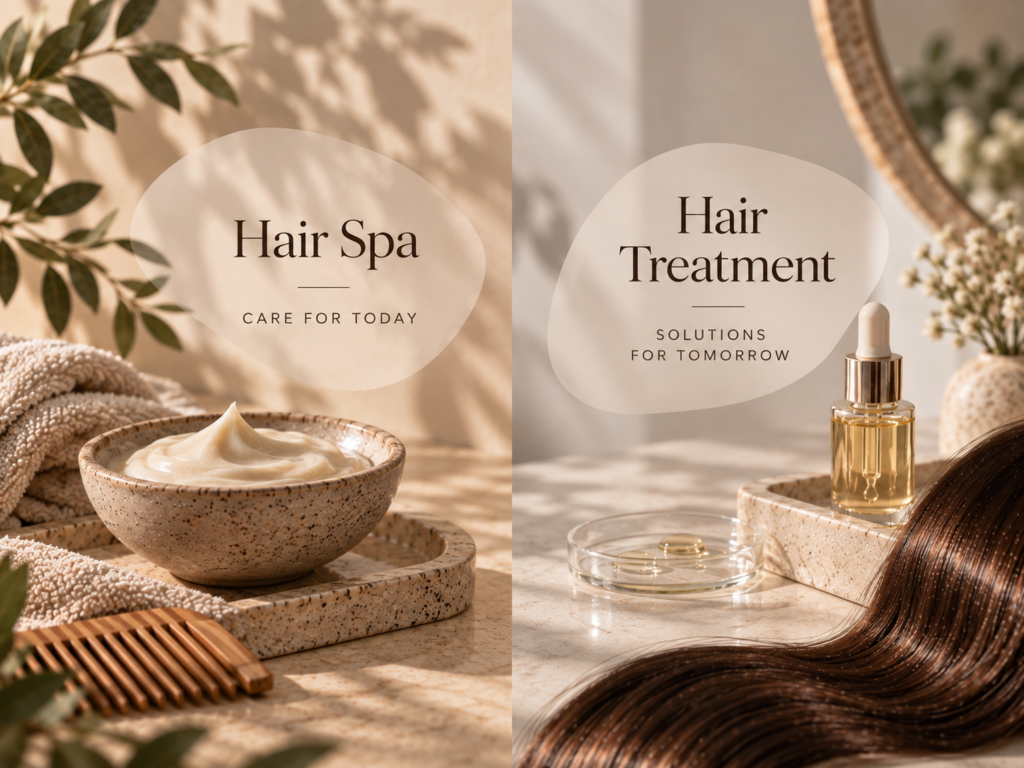
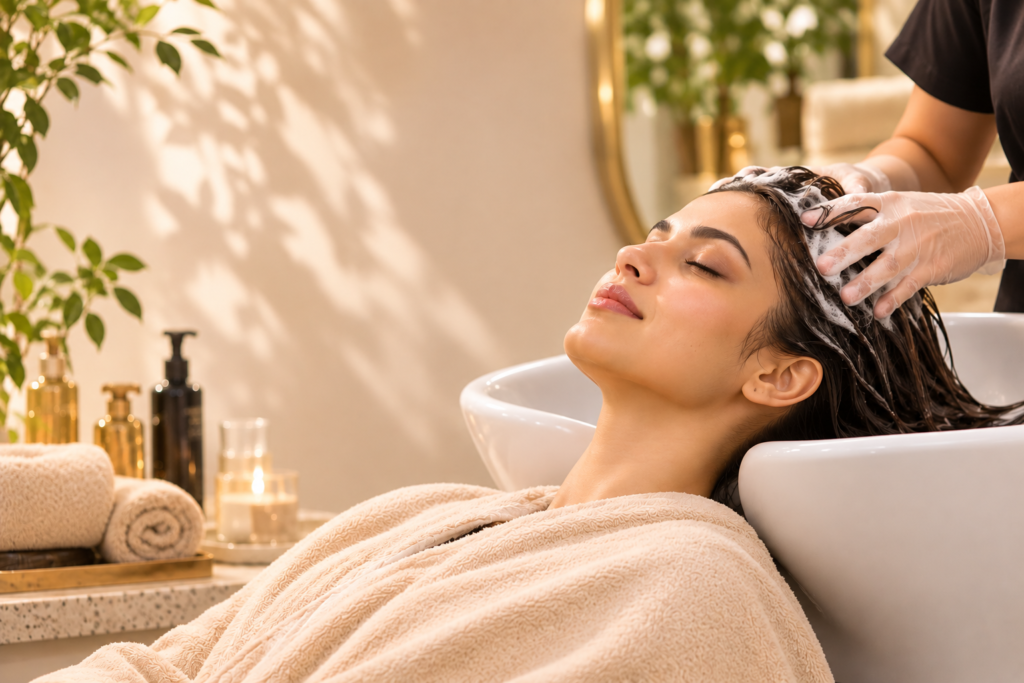
Search “hair spa” today and you will likely find two very different conversations happening at once: the traditional hair spa treatment that salons have offered for years, and the newer, viral “Korean hair spa” trend built around scalp-focused rituals. Both aim to leave your hair healthier, but they approach the problem from different starting points. Here is how they actually compare.
What a Traditional Hair Spa Involves
A traditional hair spa is generally built around deep conditioning: a nourishing mask or cream applied through the lengths of the hair, often paired with a head massage and sometimes steam, designed to repair dryness, add shine and improve manageability. The emphasis is primarily on the hair itself, treating damage, dullness and dehydration along the strands.
What a Korean-Style Hair Spa Emphasises
The Korean hair spa trend shifts the starting point from the hair to the scalp, borrowing techniques more commonly associated with facial skincare: scalp analysis, gentle exfoliation or scaling to remove buildup, steaming to open and prepare the scalp, and a slower, more deliberate massage focused specifically on scalp circulation, before any conditioning treatment is applied. The underlying idea is that scalp health is the foundation everything else depends on, so addressing it directly, rather than only conditioning the visible hair, leads to better results over time.
Comparing Technique and Tools
A traditional hair spa typically centres on a conditioning product and massage technique applied broadly across the scalp and lengths. The Korean-style approach tends to be more structured and sequential, often involving specific tools for exfoliation or scaling, a dedicated steaming step, and a scalp massage technique with more deliberate pressure points, closer in spirit to a facial treatment than a standard hair wash.
Comparing the Experience
Both treatments are relaxing, but the overall feel differs. A traditional hair spa is often a shorter, more straightforward add-on to a regular salon visit. The Korean-style ritual tends to be more involved, with more distinct steps and a stronger emphasis on the scalp-focused portion of the treatment feeling like its own dedicated experience, closer to a scalp facial than a quick conditioning treatment.
Which One Should You Choose?
If your main concern is dry, damaged or dull-feeling hair along the lengths, a traditional hair spa addresses that directly. If your concern is closer to the scalp itself, buildup, tightness, dryness at the roots, or hair that stays dull even with good conditioning, a more scalp-focused approach is likely to make a bigger difference. In practice, the two are not mutually exclusive, and the healthiest routine often involves elements of both: scalp care to address the foundation, and conditioning to repair and nourish the visible hair.
A Typical Session, Step by Step
A traditional hair spa usually follows a short sequence: a shampoo, a conditioning mask applied through the lengths, a head and shoulder massage while the mask works, sometimes with steam to help the product absorb, then a rinse and blow-dry. A Korean-style session tends to begin earlier in the chain, with a look at the scalp itself, followed by gentle cleansing or scaling to lift buildup, steaming, a longer massage focused on the scalp, and only then a nourishing treatment for the lengths. The difference is less about luxury and more about where the process starts and how much of the session is devoted to the scalp.
Common Misconceptions
- It is not a cure-all. A spa treatment of either type improves how hair and scalp feel and look, but it does not change your hair’s underlying genetics or reverse hair loss.
- More steps do not automatically mean better results. The right treatment is the one that matches your scalp and hair condition.
- “Korean” does not mean one fixed protocol. The term is used loosely, and what is offered under that name varies from place to place, which is why it helps to ask exactly what a session includes.
- A relaxing massage is not a medical treatment. Persistent itching, flaking, redness or noticeable shedding is worth having assessed by a doctor, not only treated with a spa session.
Who May Prefer Which Approach
- If your hair feels dry, rough or lacks shine along the lengths, a conditioning-led traditional spa is a good fit.
- If your scalp gets oily quickly, feels tight, or you notice product buildup, a scalp-focused session is likely to help more.
- If you colour or heat-style regularly, a combination that supports both scalp and lengths is often the most useful.
- If you want a short treatment before an event, a traditional spa is generally the easier fit.
Comparing Time and Commitment
A traditional hair spa is often a quicker, more flexible add-on that fits easily into a regular salon visit, which makes it a convenient option when time is limited. The Korean-style approach, with its multiple distinct steps, typically asks for a longer appointment and, for best results, a more consistent routine over several visits rather than a single one-off session. Neither is inherently better; the right choice often comes down to how much time you have and how committed you are to an ongoing scalp-care routine versus an occasional refresh.
Where Merakki Fits In
Merakki’s Hair Spa treatment is built around the same scalp-first principle associated with the Korean hair spa trend, nourishing hair from the scalp outward rather than treating only the surface. If you are drawn to the scalp-focused philosophy behind this trend, that same approach is already central to how our team designs a hair spa session, tailored to your scalp’s actual condition. We cover the broader trend in more detail in What Is a Korean Hair Spa? Understanding the Trend, if you want the fuller picture before booking.
FAQs
Q1. Is one of these treatments objectively better than the other?
Not necessarily. They address slightly different concerns, scalp health versus hair-length conditioning, so the better option depends on what your hair and scalp actually need.
Q2. Can I combine both approaches in one treatment?
Yes, many hair spa sessions can be tailored to include both scalp-focused techniques and deeper conditioning for the lengths. Discuss this with your technician when booking.
Q3. Does Merakki offer a specifically named “Korean Hair Spa” treatment?
Merakki’s Hair Spa treatment is built around the same scalp-first philosophy associated with this trend. Speak with our team about tailoring a session around scalp massage, steaming and deep conditioning.
Q4. How do I know if my scalp needs more attention than my hair lengths?
Signs like an itchy, tight or oily scalp, visible buildup, or hair that stays dull despite good conditioning often point to a scalp-focused treatment being the more useful starting point.
Q5. How often should I get a hair spa treatment?
This depends on your hair and scalp condition and your at-home routine. A consultation can help determine a schedule suited to you.
Discover What Your Hair and Scalp Actually Need
Whether it’s deep conditioning, scalp care, or both, book an appointment with Merakki in Faridabad for a treatment tailored to you.