
Of all the questions men ask before considering a hair patch, this is the one that matters most. Everything else, maintenance, cost of time, how it is fitted, is secondary if the end result does not actually look like real hair. The honest answer is that it depends entirely on how the patch is designed and fitted, not on the concept of a hair patch itself. Here is what actually determines whether a hair patch looks convincing or not.
Colour-Matching Is the First Test
Hair is rarely one flat shade. It carries subtle variation, slightly lighter near the crown from sun exposure, a touch of natural grey coming through at the temples, tonal shifts between strands. A patch coloured to a single, uniform shade will always look slightly artificial next to hair that has this natural variation. A proper colour match accounts for these subtleties rather than simply picking the closest shade from a chart, which is one of the main reasons a professional fitting looks fundamentally different from a generic, off-the-shelf piece.
Density Has to Match, Not Just Colour
A patch that is too dense looks noticeably thicker than the hair around it, which is often the detail that gives away a poor fitting faster than colour ever does. Natural hair density varies by area of the scalp and by individual, and a well-designed patch is built to match the client’s actual density rather than defaulting to a “fuller is better” assumption. This is part of why a scalp analysis matters before anything is made: density that looks right on one person can look obviously artificial on another.
Hairline Design Is Where Most Results Succeed or Fail
A straight, uniform hairline is one of the most common tells of a poorly designed patch, because real hairlines are irregular. They have slightly uneven edges, finer, sparser hairs right at the front, and a shape that is unique to the individual. Designing a hairline that mimics this irregularity, rather than a clean, uniform line, is one of the most technically demanding parts of building a natural-looking patch, and it is where the skill of the person designing it matters most.
The Base Material Matters More Than People Expect
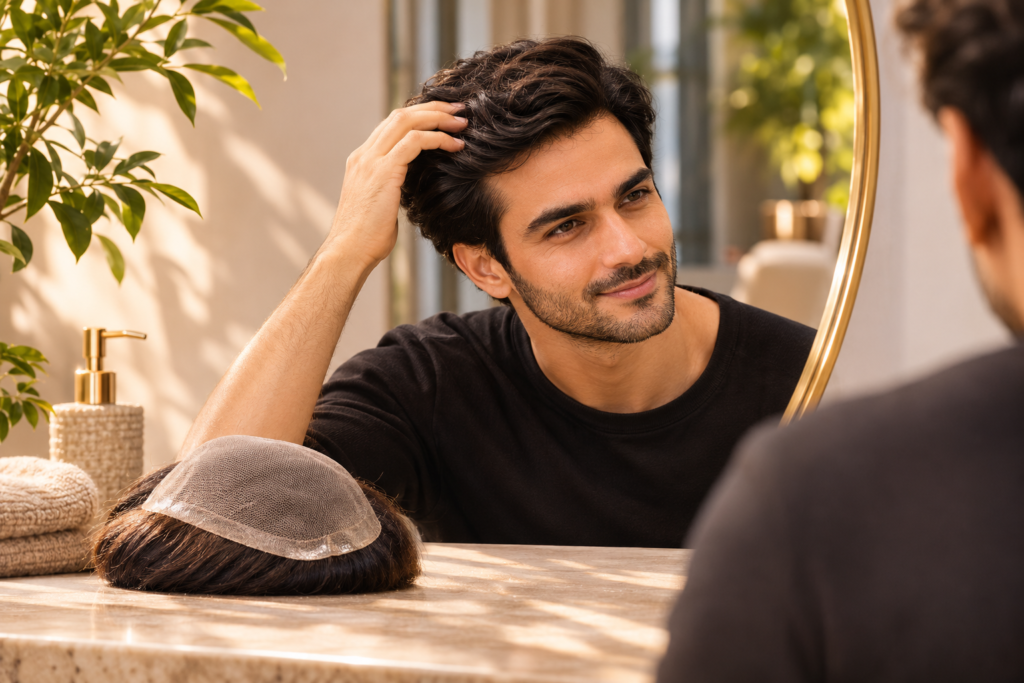
The base a patch is built on affects how it sits, moves and catches light. A thin, breathable mesh base allows the scalp to show through subtly in the right places, the way a real scalp does beneath real hair, rather than presenting a solid, opaque surface. This detail is easy to overlook when comparing options but makes a meaningful difference to how convincing the final result looks, especially in direct light or close up.
Why the Maintenance Cut Is Not Optional
Even a perfectly made patch will look artificial if it is not blended properly into the client’s own surrounding hair. The maintenance haircut that finishes a professional fitting is what ties the patch and natural hair together into one continuous look, rather than leaving a visible line where the two meet. At The PatchLab by Merakki, every fitting includes a 360° scalp analysis, a bespoke patch built to match colour, density and hairline, and a private fitting finished with exactly this kind of blending cut.
Scalp Analysis: Where a Natural Result Begins
Before a patch is designed, the scalp itself needs to be understood. Skin tone, the natural direction in which your hair grows, the pattern of thinning and how much of your own hair remains all shape what will look believable. A patch that ignores the way your own hair falls will sit against it awkwardly, even if the colour is a perfect match. This is why a 360° scalp analysis comes first in The PatchLab process, well before any hair is chosen or any base is made.
Hair Direction, Texture and Parting
Natural hair does not fall in one uniform direction. It grows in a specific pattern around the crown and along the hairline, and it carries a texture of its own, whether straight, wavy or slightly curled. A patch that matches your texture and respects your natural parting and growth direction moves the way your own hair does, which is a large part of why it reads as real in motion and not only in a still photograph. It also explains why a patch chosen without reference to your own hair can look fine on a mannequin and wrong on you.
What to Look For Before You Commit
If you are evaluating a hair patch provider, a few direct questions will tell you a great deal about the likely result:
- Is the colour matched to my hair in natural light, or only under showroom lighting?
- Is the density customised to my scalp, or chosen from a standard range?
- How is the hairline designed, and can I see examples of the front edge up close?
- What base material is used, and how does it sit against the scalp?
- Is a blending haircut part of the fitting, and what does ongoing maintenance involve?
Clear, specific answers to these questions are a good sign. Vague answers, or an emphasis on speed over fit, are worth pausing on.
How a Natural Look Holds Up Over Time
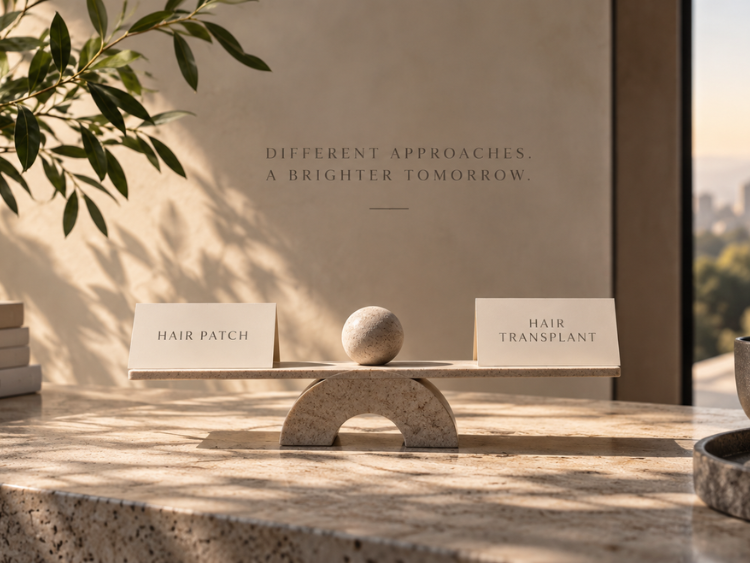
A patch that looks convincing on the day it is fitted is only half the picture. Your own hair grows, your scalp changes gradually, and the patch itself experiences normal wear. A natural look over the months that follow depends on regular maintenance: refreshing the blend, adjusting the fit as your own hair grows, and keeping the base and hair in good condition. Our guide to hair patch maintenance and aftercare covers what this looks like in practice. If you are still weighing your options, our comparison of hair patch vs hair transplant explains how the two routes differ, and our piece on the signs a hair patch may be right for you is a useful way to work out where you stand.
The Bottom Line
A natural-looking hair patch is less about the general idea working and more about every one of these details being handled properly. If you have seen an unconvincing hair patch before, in person or in photos, the issue was very likely one or more of these factors, not the concept itself. For a broader look at some of the misconceptions this creates, our piece on Hair Patch Myths vs Reality is worth reading alongside this one.
FAQs
Q1. Can a hair patch really be undetectable up close?
Yes, when colour, density, hairline design and the maintenance cut are all handled properly. These details, not the concept of a hair patch, are what determine how convincing the result is.
Q2. Why do some hair patches look more obviously fake than others?
Usually because one or more key factors, colour match, density, hairline shape or the finishing haircut, was not properly customised to the individual.
Q3. Does hair type affect how natural a patch looks?
Yes. The base material, hair texture and density all need to be matched to the client’s natural hair type for the most seamless result.
Q4. How long does the design and fitting process take?
This varies by individual case. A consultation and scalp analysis is the first step, after which your technician can walk you through the expected process.
Q5. Is it obvious when the patch needs a touch-up or has grown out?
Regular maintenance appointments are designed to catch this before it becomes noticeable. Our maintenance and aftercare guide covers what to expect between visits.
See the Difference a Proper Fitting Makes
The best way to judge how natural a hair patch can look is a consultation, not guesswork. Book an appointment with The PatchLab by Merakki in Faridabad.